
Training Course
Machine Polishing & Ceramic Coating.
Learn the fundamentals of machine polishing, paint inspection and safe correction. A practical, hands-on training day designed to teach you how to safely assess paintwork, understand paint defects and use machine polishing techniques to achieve a cleaner, glossier and more refined finish.
£495 · Full-Day Practical Training · Class Size: 1-to-1 · London
What You'll Learn
The course takes you through the process from initial inspection to final inspection.
You'll gain an understanding of not only how to polish paint, but why different techniques are used.
01
Paintwork Inspection
- Identifying different types of paint defects
- Swirl marks and wash marring
- Fine scratches and random isolated deeper scratches
- Oxidation, dullness, water spotting and etching
- Bird-dropping and chemical etching
- Assessing overall paint condition
- Understanding when a defect should not be chased
02
Understanding Paint Thickness
- How a paint thickness gauge works
- Taking consistent readings across panels
- Why measurements vary between panels
- Identifying previously repaired or repainted areas
- Why thin or inconsistent areas require caution
- How paint thickness influences correction strategy
- Why you should never assume clear-coat depth is uniform
03
Understanding Paint Defect Depth
- Light surface defects vs deeper clear-coat defects
- Defects beyond safe correction
- Why removing every scratch can cause more damage
- Assessing realistic improvement vs complete removal
04
Machine Polisher Fundamentals
- Dual-action machine polishers
- Machine setup, pad selection and polish selection
- Working areas, speed, pressure and arm movement
- Working time and panel temperature
- Cleaning and maintaining pads
- How pad, polish, machine and technique work together
05
Paint Correction Process
- Performing a controlled test spot
- Determining what combination works
- How much correction is achievable
- How aggressive you actually need to be
- When multiple stages are required
- When to stop
06
Single-Stage Polishing
- Choosing an appropriate pad and polish
- Establishing a working area
- Correct machine movement
- Controlling pressure
- Inspecting your results
- Knowing when you've achieved enough correction
07
Multi-Stage Paint Correction
- Cut → refine → finish
- When a more aggressive combination is required
- Why a refining stage improves clarity and finish
- Planning multi-stage work safely
08
How to Ceramic Coat a Car
- What ceramic coating is and what it does
- Panel preparation before coating
- Surface cleansing and decontamination
- Application technique and coverage
- Flash times and levelling
- Curing and aftercare basics
- Common mistakes to avoid
09
Inspection & Quality Control
- Identifying remaining defects
- Checking for haze or micro-marring
- Checking panel consistency
- Inspecting edges and difficult areas
- Removing polishing residue
- Final inspection under different lighting conditions
The Science Behind Paint Correction
Paint correction isn't simply about making paint "shiny."
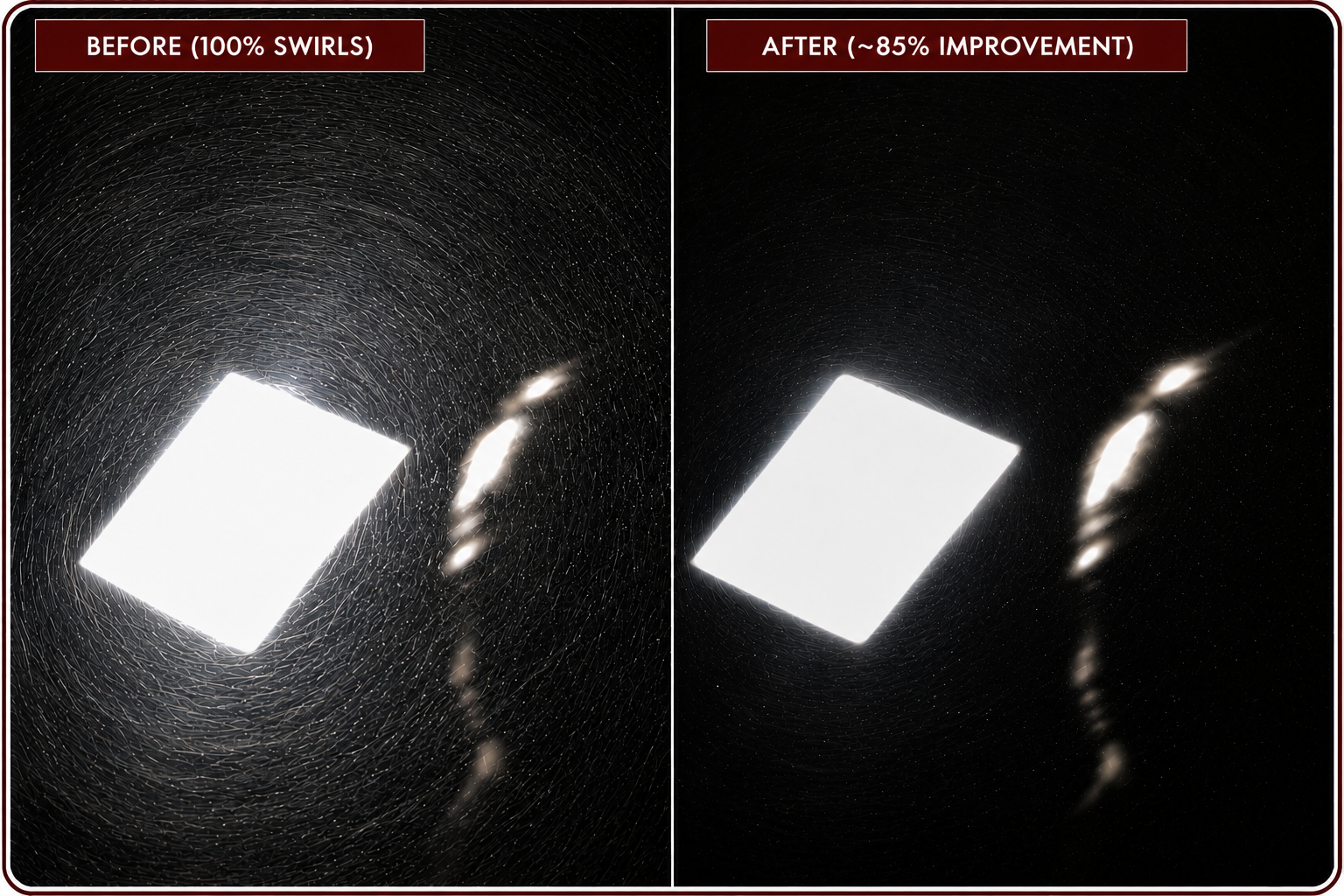
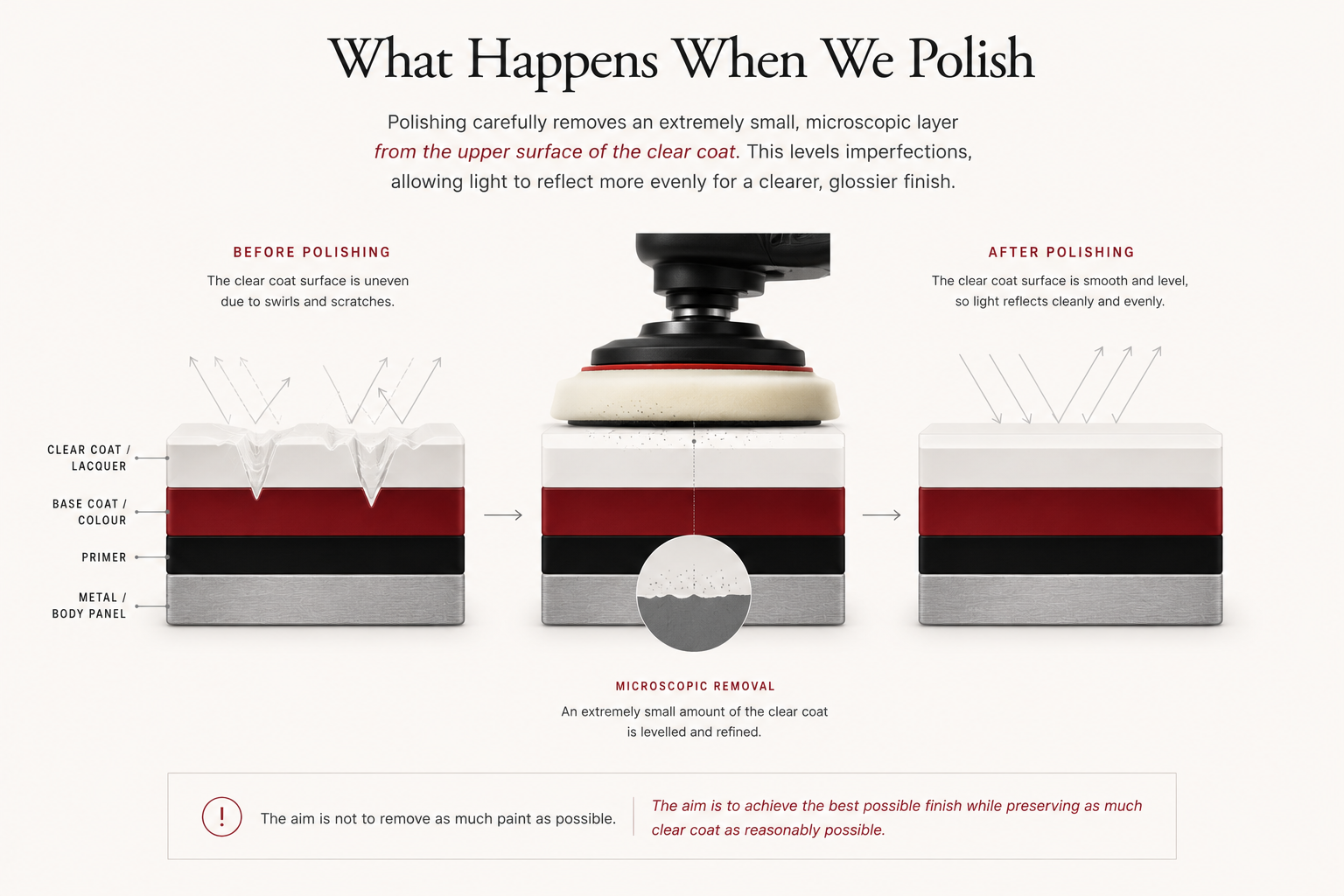
Machine polishing uses an abrasive compound and polishing pad to refine the upper surface of the clear coat. Defects alter the surface and therefore affect how light is reflected from the paint. By carefully refining the surface, suitable imperfections can be reduced and the surface can reflect light more evenly — producing greater clarity, gloss and visual depth.
The important part is understanding that the clear coat is a finite material. Every correction decision involves a balance between defect removal and paint preservation.
Practical Training
This isn't designed to be a classroom-only course.
A significant part of the day is hands-on. You'll work through the process yourself under guidance:
Inspect → Measure → Assess → Test Spot → Correct → Refine → Inspect → Protect
You'll learn how to make decisions throughout the process rather than simply following a set machine-polishing routine.
What's Included
Your training day includes:
Full-day practical training
Paintwork inspection
Paint thickness measurement
Machine polisher setup
Pad and polish selection
Paint defect identification
Test-spot methodology
Single-stage correction
Multi-stage correction principles
Practical machine polishing
Finishing techniques
Ceramic coating application guidance
Quality-control inspection
Paint protection fundamentals
Instructor guidance throughout
Training Format
Price
£495
Duration
1 Full Day
Location
London
Class Size
1-to-1
Level
Beginner / Intermediate
Equipment
Supplied during training
Who Is This Course For?
Beginners
Those with little or no machine polishing experience who want to learn the correct fundamentals from the beginning.
Detailers Looking to Expand
Existing detailers who already offer valeting and want to introduce machine polishing and paint correction into their services.
Enthusiasts
Vehicle owners who want to develop the knowledge and confidence to work on their own vehicles safely.
After Your Course
What you should be able to do after the course:
Inspect vehicle paintwork
Identify common paint defects
Take and interpret paint thickness readings
Assess whether a defect is suitable for correction
Select an appropriate pad and polish combination
Perform a controlled test spot
Operate a machine polisher correctly
Carry out a single-stage correction
Understand multi-stage correction
Inspect your work properly
Apply a ceramic coating with correct technique and coverage
Finish and protect corrected paintwork
Make safer, more informed correction decisions
Important
Paint correction has limits.
Not every scratch can or should be removed. If a defect extends too deeply into the paint system, attempting to completely remove it may require removing an unsafe amount of material. Professional paint correction is therefore not about achieving 100% defect removal at any cost — it's about achieving the best realistic improvement while preserving the integrity of the paintwork.
Frequently Asked Questions
Do I need previous experience?+
No. The course is designed to introduce beginners to the fundamentals while also being useful for those with some detailing experience.
Do I need my own machine polisher?+
No. Equipment required for the practical training is provided.
Will I learn how to remove scratches?+
You'll learn how to assess different types of scratches and determine which defects may be safely reduced through machine polishing. Not every scratch can safely be removed.
Do you teach paint thickness measurement?+
Yes. Paint thickness measurement is an important part of the inspection process and is covered during the course.
Will I learn both single-stage and multi-stage correction?+
Yes. The course covers the principles and practical techniques behind single-stage correction, as well as the principles of multi-stage correction.
Is this a qualification?+
A certificate of attendance/completion is provided following the course.
Is the course one-to-one?+
Yes. This course is provided on a 1-to-1 basis.
Ready to Develop Your Skills?
Learn the process. Understand the paint. Correct with confidence.
A full day of practical machine polishing and paint correction training designed around safe working practices, paint preservation and real-world detailing techniques.