
Paint Structure
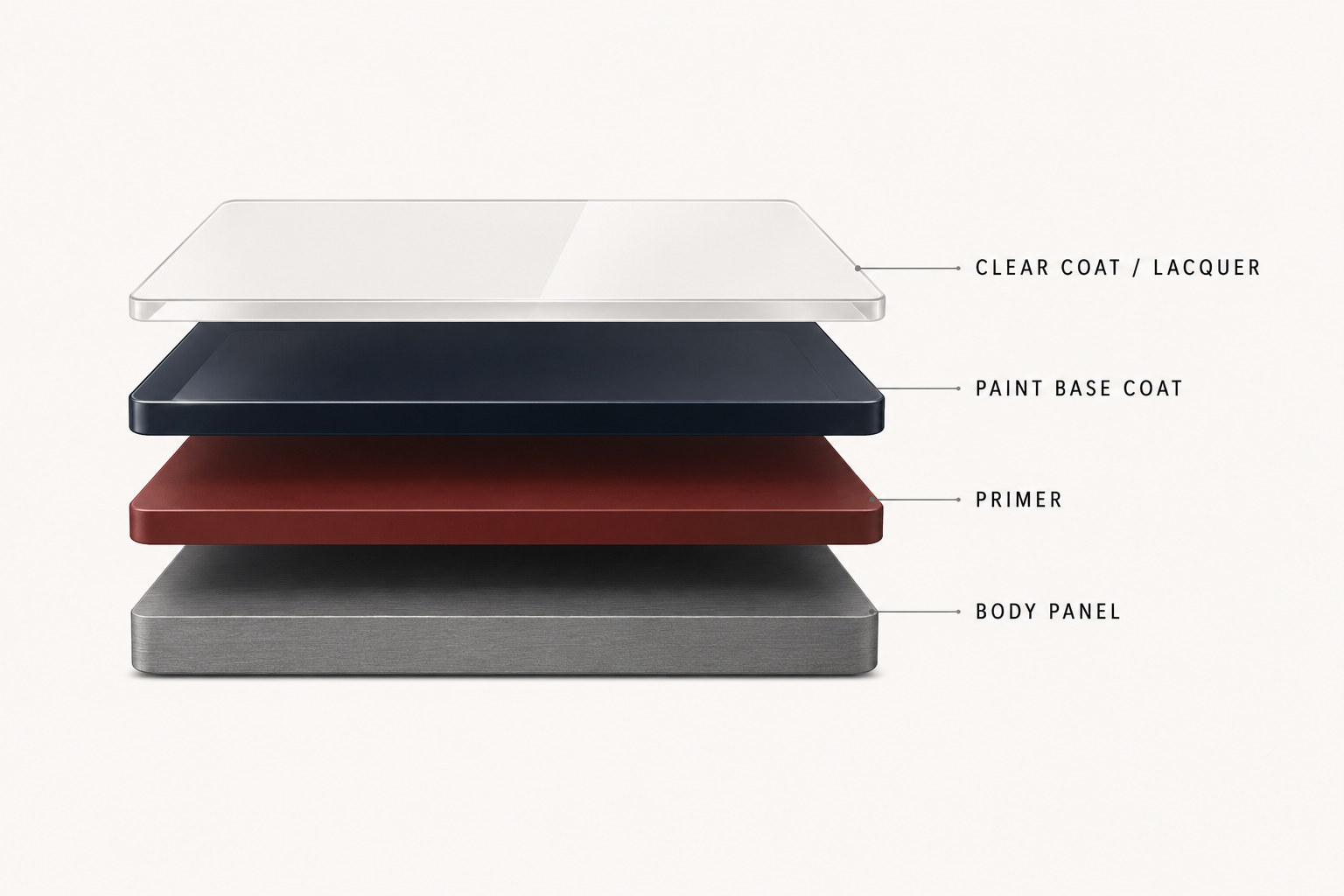
Your car is made up of layers.
Your vehicle's exterior paintwork typically consists of several layers, each serving a different purpose.
Defect Depth
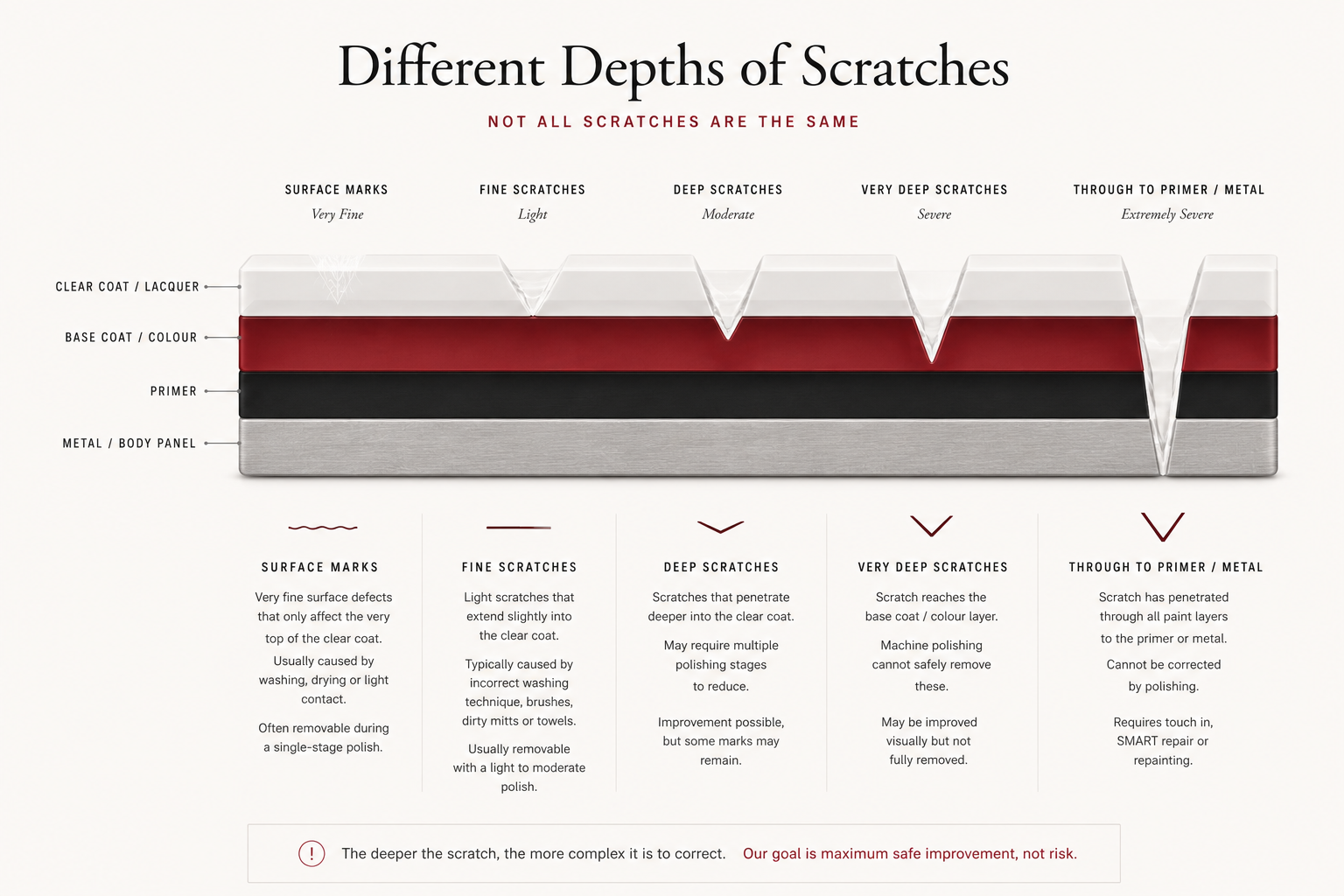
Scratches and swirl marks vary in depth.
Scratches and swirl marks can vary significantly in both their depth and severity, and this determines whether they can be safely reduced or removed through paint correction. Very fine surface marks and swirl marks typically affect the upper portion of the clear coat and can often be significantly reduced or removed through polishing.
Deeper scratches can extend further into the clear coat and may require more intensive correction, such as a combination of cutting and refining. If a scratch has penetrated completely through the clear coat and into the base coat, primer or metal, machine polishing cannot safely remove it because the missing paint cannot be restored through polishing.
The deeper the defect, the greater the risk of removing too much clear coat. The aim is always to achieve the maximum safe improvement rather than simply chasing complete removal of every scratch.
How & Why We Measure
Paint Thickness.
Before machine polishing, we assess the paint thickness across the vehicle using a professional paint thickness gauge. This allows us to assess the overall thickness of the paint system, identify significant variations between panels and recognise areas that may require a more conservative approach. Differences in readings can also help highlight panels that may have been previously repaired or resprayed.
Paint thickness readings help us make informed decisions about how aggressively we can polish each area. Not every panel has the same thickness, and previous correction work or paint repairs may affect the amount of clear coat remaining, but a paint thickness gauge measures the total paint system rather than the clear coat alone. This is why readings are considered alongside visual inspection, panel history and test spots. By measuring before we begin, we can tailor our polishing approach to the condition of the vehicle rather than treating every panel in exactly the same way.
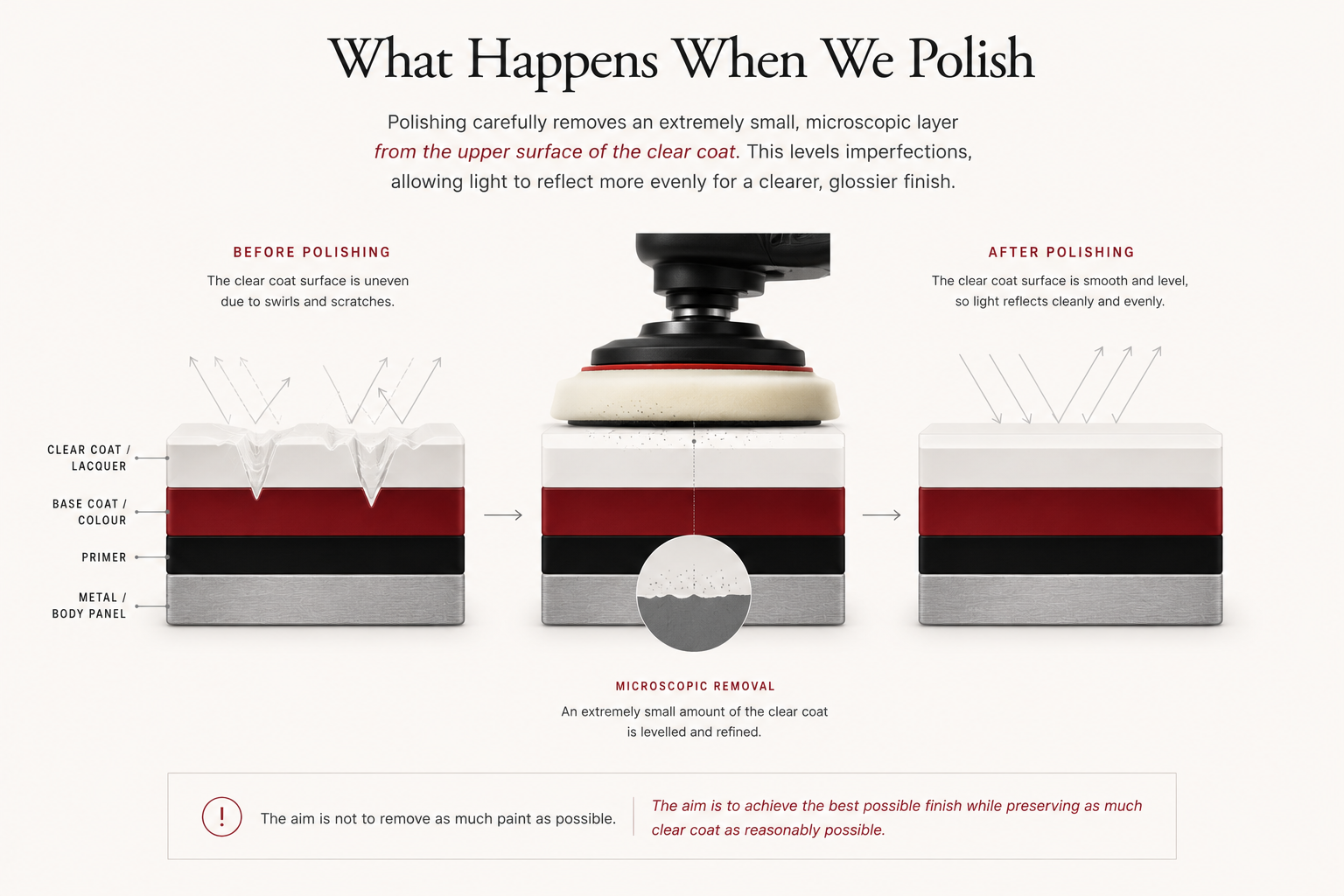
The objective is not to remove as much clear coat as possible. Machine polishing removes a microscopic amount of material from the upper surface of the clear coat, so preserving as much of the original paint system as reasonably possible is an important part of responsible paint correction.
Assessment
Safety
Strategy
Accuracy
Preservation
What the readings tell us
- Paint thickness gauge — Measures the total thickness of the paint system over the panel.
- Panel-to-panel comparison — Helps identify areas that differ significantly from surrounding panels.
- Thin or sensitive areas — May require a more conservative polishing approach.
- Previous repairs — Large variations in readings can indicate areas that have been repainted or repaired.
- Correction strategy — Readings help us determine the appropriate level of machine polishing for each area.
Why this matters
Paint correction is a balance between improving the appearance of the paint and preserving the paint system. Thickness measurements give us another layer of information before we put a machine and abrasive against the vehicle.
Measure first. Polish with purpose. Preserve wherever possible.
The Process
What happens when we polish your vehicle.
When we polish your vehicle, we use a combination of a machine polisher, polishing pad and fine abrasive compounds to remove an extremely small, controlled amount of material from the upper surface of the clear coat. This process gradually levels the microscopic imperfections within the clear coat, such as fine scratches, swirl marks and light surface defects, allowing light to reflect more evenly from the paintwork.
The result is a smoother, clearer and more refined surface with improved gloss and depth. Because the clear coat is a finite layer, our approach is always to remove as little material as reasonably necessary to achieve the desired improvement, rather than unnecessarily thinning the paintwork.
FAQs
Paint Correction — Questions Answered.
Does paint correction remove scratches completely?
How do I know if my scratch can be polished out?
Does paint correction remove clear coat?
Will paint correction damage my paint?
Can every scratch be removed?
Why do I still see some scratches after correction?
What is the difference between a one-stage, two-stage and three-stage correction?
Does paint correction make the paint thinner?
Can paint correction remove swirl marks?
Can paint correction remove oxidation?
Does paint correction remove stone chips?
Does paint correction protect my car?
Should I ceramic coat my car after paint correction?
Can paint correction remove water spots?
How long does paint correction last?
Will the car stay swirl-free after correction?
Is paint correction suitable for a new car?
How many times can my car have paint correction?
Why does paint correction make the car look so much glossier?
Is paint correction the same as polishing?
Next Step
Ready to restore your paintwork?
Book an assessment and we'll recommend the right level of correction for your vehicle's paint condition.