The Science
The science behind valeting & detailing
Cleaning is a process of controlled contamination removal.
A professional detail is not simply about making a vehicle look clean. Every stage is designed to safely loosen, remove and extract dirt while reducing unnecessary contact with the vehicle's surfaces.
From the initial pre-wash to the final drying process, the objective is simple: remove contamination without causing avoidable damage.
01 — Pre-Wash
Why do we pre-wash?
The first contact with the paint should remove as much loose contamination as possible.
During normal driving, your vehicle collects road film, dust, grit, traffic film, oils, brake dust and other environmental contamination. Much of this sits loosely on the surface, but some particles can become firmly attached.
A pre-wash uses a combination of water, chemical cleaning agents and controlled dwell time to loosen and break down this contamination before physical contact is made with the paint. This is important because every time a wash mitt or cloth touches the vehicle, there is a possibility of moving particles across the surface.
The less contamination remaining on the paint before contact washing begins, the lower the risk of introducing wash-induced marring and swirl marks.
The principle
Loosen → Rinse → Contact Wash
Rather than immediately rubbing the dirt away, we first try to remove as much of it as possible without touching the paint.
02 — Swirl Marks
Why does contact washing create swirl marks?
It's not usually the wash mitt itself — it's what gets trapped between the mitt and the paint. Road grime can contain fine abrasive particles such as dust, grit and mineral contamination.
If these particles remain on the vehicle and become trapped inside a wash mitt or towel, physical pressure can drag them across the paintwork. Repeated over many washes, this can create extremely fine scratches and marring in the clear coat — often visible as swirl marks, particularly under direct sunlight or strong artificial lighting.
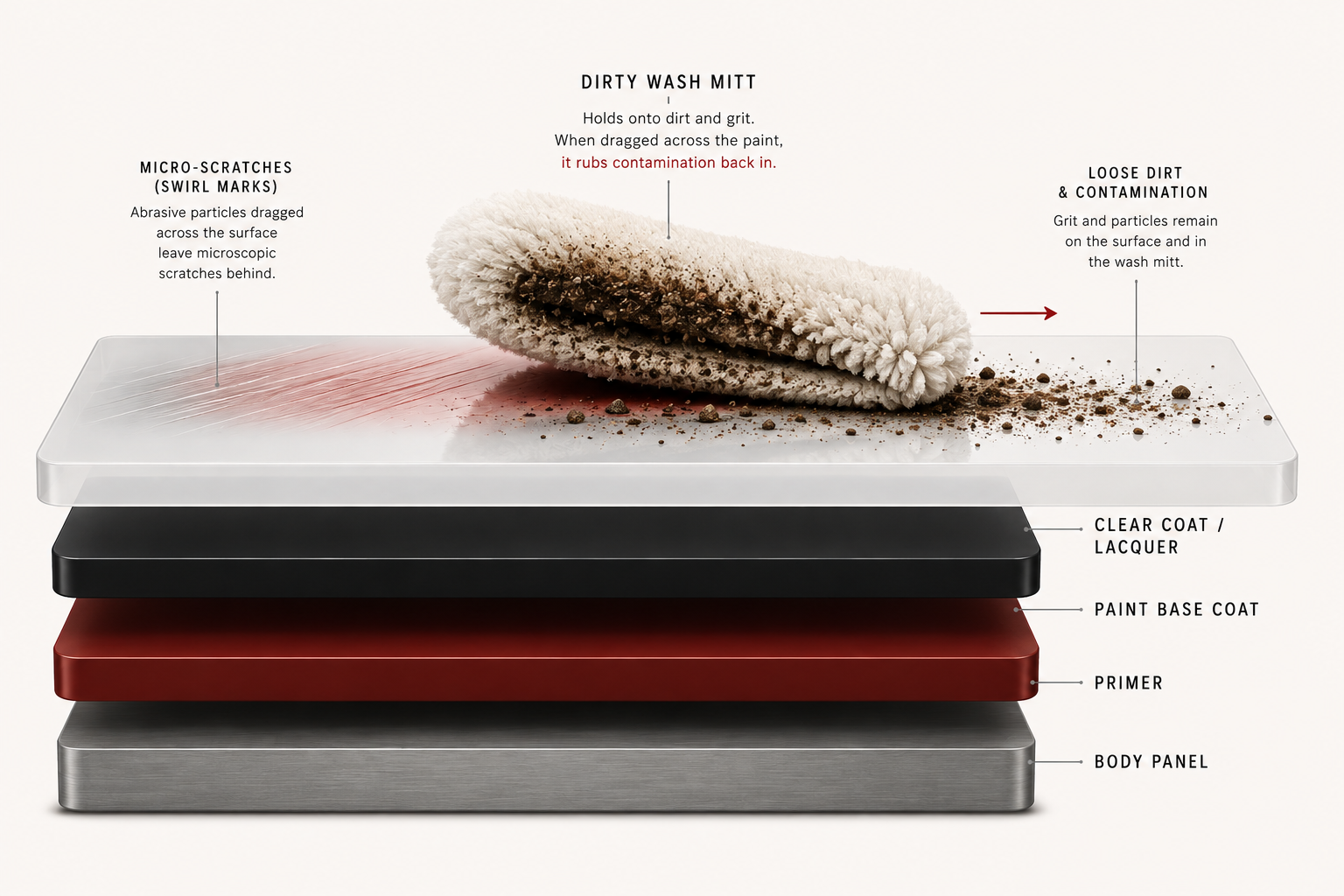
- Dust and grit trapped in the wash mitt
- Mineral contamination in road grime
- Too much physical pressure during washing
- Repeated washing without proper lubrication
This is why professional washing focuses on lubrication, contamination removal and minimising unnecessary pressure.
03 — Wash Media
Why clean wash media matters
A wash mitt or microfibre towel can collect contamination during use. If that contamination is not properly released, or the same dirty cloth is repeatedly used across different areas of the vehicle, particles can be transferred from one surface to another.
Professional detailing therefore relies on clean, suitable wash media and controlled washing techniques to reduce cross-contamination.
Wheels
↓
Bodywork
Lower panels
↓
Upper panels
Interior
↓
Paintwork
The goal isn't simply to wash the car. It's to prevent the dirt we have removed from being put back onto the car.
04 — Spotless Water
Why we use spotless water
The quality of the water we use plays an important role in the final finish of a vehicle. Ordinary tap water contains naturally occurring dissolved minerals and salts, such as calcium and magnesium. When water evaporates from the surface, the water disappears but these dissolved minerals can remain behind — forming the familiar white spots and mineral deposits often seen on paint and glass.
At Dipped In Detail, we use spotless, purified water, which has been treated to remove the majority of these dissolved minerals and impurities. When the water evaporates from the vehicle, there is significantly less mineral residue left behind — particularly beneficial on dark paint, glass and ceramic-coated vehicles, where even small deposits can be highly visible.
Using purified water also reduces the need for excessive wiping or drying to remove water marks. Every additional contact with the paint creates another opportunity for dirt or particles to cause light marring, so reducing unnecessary contact is an important part of a safe detailing process.
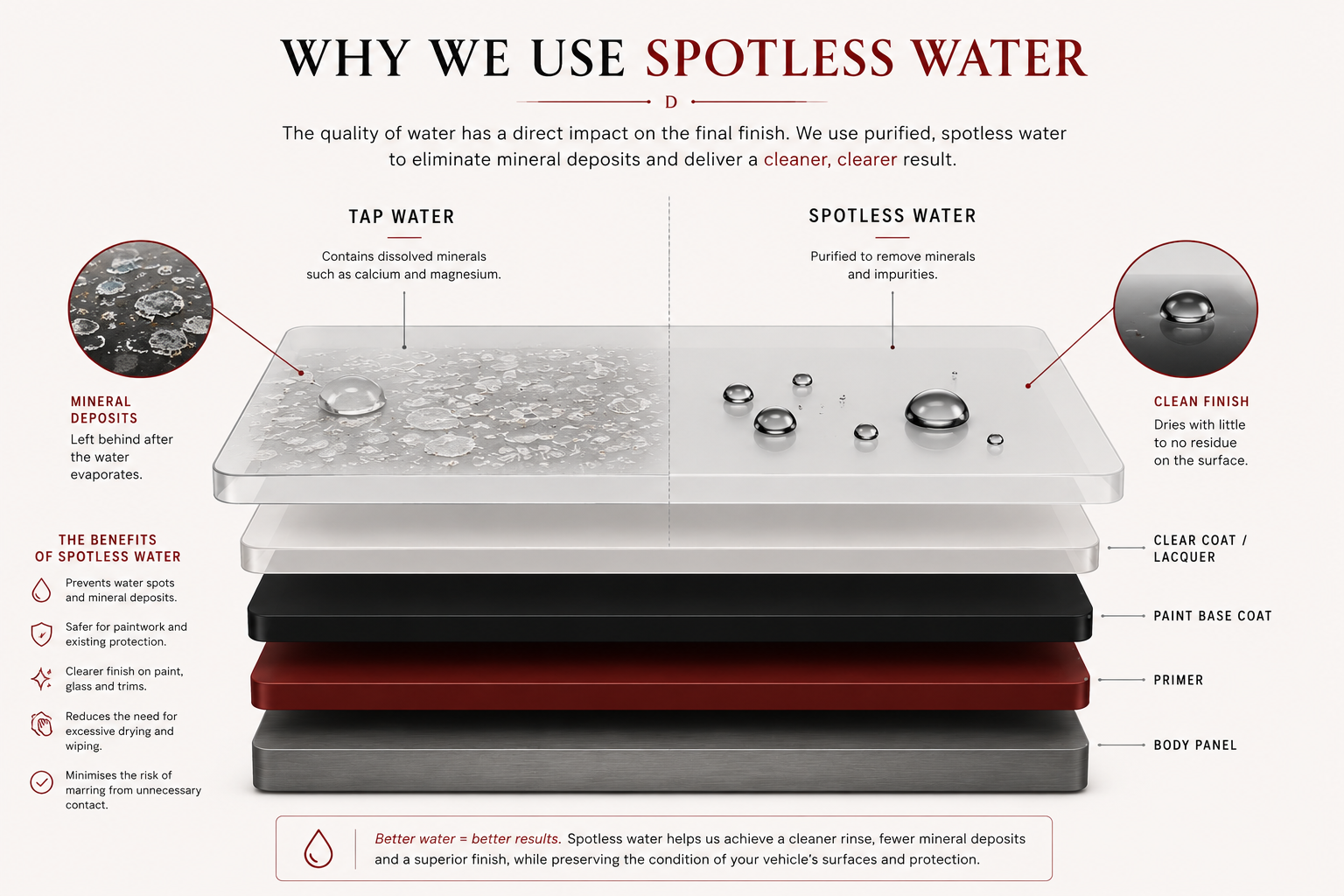
The result is a cleaner final rinse, fewer mineral deposits and a clearer finish, while helping maintain the condition of the paint and existing protective coatings. A better finish starts with better water.
05 — Chemistry
TFR vs pH-neutral car shampoo
Not all car washes are the same.
Many commercial and automated car washes use Traffic Film Remover (TFR) to quickly break down heavy road grime, grease and traffic film. TFR is generally a much stronger, often alkaline cleaning chemical designed for speed and efficiency rather than long-term paint care.
While correctly diluted TFR can be useful for certain applications, frequent or incorrect use can be unnecessarily harsh on a vehicle's exterior. Strong alkaline cleaners can strip waxes and sealants, affect unprotected trims and rubbers, and may reduce the performance of existing protective products over time.
At Dipped In Detail, we take a more controlled approach. Where appropriate, we use pH-neutral shampoos and cleaning products that are formulated to safely clean the vehicle while being much gentler on the paintwork and existing protection.
Why does pH matter?
The pH scale measures how acidic or alkaline a substance is. A pH-neutral product sits around pH 7, making it less aggressive than highly acidic or alkaline cleaners.
A pH-neutral shampoo is designed to lift and lubricate contamination, allowing dirt to be safely removed with minimal friction rather than relying solely on aggressive chemistry. This is particularly important on vehicles protected with ceramic coatings, waxes or sealants, where maintaining the protective layer is just as important as cleaning the vehicle itself.
Our approach
We don't believe the strongest chemical is necessarily the best chemical. Our process combines pre-wash, controlled chemical cleaning, high-quality wash media and safe drying techniques to remove contamination while minimising unnecessary contact with the paint.
Clean the vehicle — without unnecessarily attacking the protection underneath.
Important: pH-neutral does not mean "weak" or incapable of cleaning heavy contamination. Different stages of the wash use different products for different types of contamination, and the correct chemical, dilution and application method are what matter.
06 — Steam Cleaning
The science behind steam cleaning
Heat helps loosen contamination without relying entirely on aggressive chemicals. Steam cleaning uses high-temperature vapour to help soften and loosen certain types of dirt, oils and residues from interior surfaces and hard-to-reach areas. The heat can help break the bond between contamination and the surface, allowing it to be lifted more easily.
- Air vents
- Buttons and switches
- Door trims
- Centre consoles
- Seams and crevices
- Plastic surfaces
Steam is not a replacement for every cleaning method. Different materials and contaminants require different techniques, and excessive heat or moisture can damage sensitive surfaces. The process relies on controlled temperature, distance, dwell time and appropriate technique.
07 — Compressed Air
Why do we use compressed air?
Some of the dirtiest areas of a vehicle are the places you can't easily reach with a towel. Compressed air allows us to dislodge dust, debris and moisture from areas such as:
- Air vents
- Button surrounds
- Seat rails
- Door shuts
- Wheel spokes
- Badges & emblems
- Grilles
- Tight panel gaps
It is also extremely useful during the drying process. Instead of forcing a towel into every gap, compressed air can push trapped water out of crevices, reducing the amount of water that later runs back onto the vehicle — particularly useful around mirrors, grilles, badges, trims and panel gaps.
FAQs
Common questions
Can washing actually scratch my car?+
Yes. If abrasive contamination is dragged across the paint during washing, it can create fine marring and swirl marks. Proper pre-washing, lubrication, clean wash media and controlled technique help minimise this risk.
Why can't you just pressure wash the whole car?+
Pressure washing is excellent for removing loose contamination, but it cannot remove everything. Some contamination remains bonded to the surface and requires controlled contact washing.
Does pre-wash remove everything?+
No. Pre-wash is designed to remove as much loose and softened contamination as possible before contact washing. It does not replace the contact-wash stage.
Can a dirty wash mitt scratch paint?+
Yes. A mitt that has collected abrasive contamination can transfer those particles back onto the paint. This is why wash media management is so important.
Why do you use different towels?+
Different areas carry different levels and types of contamination. Keeping towels separated reduces cross-contamination and prevents wheel or interior contamination being transferred to paintwork.
Does steam kill bacteria?+
Steam can reduce microbial contamination when sufficient temperature and contact time are achieved, but it should not be described as automatically sterilising every surface. Its primary detailing benefit is helping loosen contamination with controlled heat and moisture.
Does wet vacuuming remove stains completely?+
Not always. The result depends on the type, age and depth of the stain and the material being cleaned. Some staining may be permanent or require specialist treatment.
Why do you use compressed air?+
To remove dust, debris and trapped water from areas that are difficult to reach with towels, while reducing unnecessary physical contact with the surface.
Why do I still get water spots after a detail?+
Water spots can form when water evaporates and leaves dissolved minerals behind. Proper drying reduces the risk, but contamination in the water supply and environmental conditions can still contribute.
Ready When You Are
Experience a proper detail.
Every stage of our process is designed to remove contamination safely — book your detail today.
Book Now