Why Leather Needs It
The hardest-working surface in your car
Leather is designed to be durable, but the surfaces inside your vehicle are exposed to constant contact, friction, oils, perspiration, UV radiation, dye transfer and everyday contamination.
A professional leather coating creates a thin, transparent protective layer over the leather surface, helping to reduce the amount of direct contact between the leather and these contaminants. Unlike a traditional conditioner, which primarily nourishes or conditions the material, a coating is designed to provide surface protection and resistance while preserving the appearance and feel of the leather.
- Friction from clothing
- Body oils and perspiration
- UV exposure
- Dirt and dust
- Denim and dye transfer
- Food and drink contamination
- Repeated hand contact
- Abrasion from everyday use
A coating doesn't make leather indestructible, but it can reduce the impact of everyday contamination and make the surface easier to maintain.
What It Is
What is leather coating?
Leather coating is a specialist protective product formulated to bond to the surface of automotive leather and create a durable, low-profile protective barrier.
Once cured, the coating becomes an additional protective layer above the leather. It does not replace the leather or significantly alter its appearance; instead, it helps shield the surface from the everyday contaminants and contact that contribute to premature wear.
The result is leather that is easier to maintain, more resistant to staining and contamination, and better protected against the effects of everyday use.
The Science
What changes at the surface
Automotive leather is not simply a solid, impermeable surface. Its surface contains a complex structure of fibres, texture and a protective finish.
Everyday use introduces contaminants onto this surface: skin oils, perspiration, clothing dye, food and drink, dirt and friction. Over time, repeated exposure can contribute to discolouration, staining, surface degradation and premature wear.
A leather coating works by forming a protective film across the finished leather surface. Once cured, this layer provides an additional barrier between the leather's finish and external contamination. Rather than allowing contaminants to interact as directly with the leather surface, the coating helps resist their adhesion and makes them easier to remove during routine cleaning.
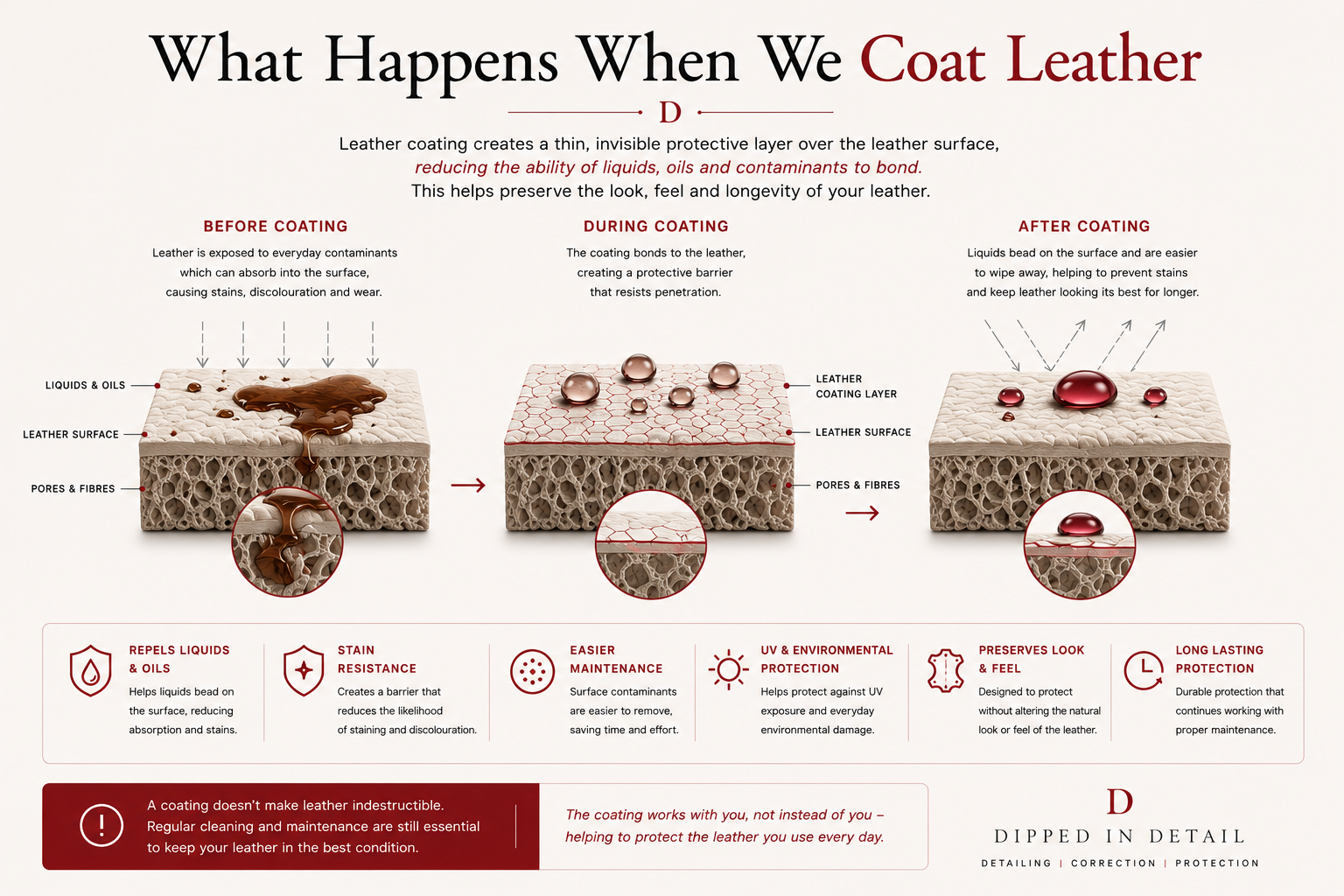
In simple terms: leather surface → coating → everyday contamination. The coating acts as the protective interface between the leather and the environment.
Benefits & Properties
What leather coating helps with
Protection
The primary purpose of a leather coating is to provide an additional protective barrier over the leather surface, helping preserve its appearance and condition.
Chemical & Contamination Resistance
The coating helps resist everyday contaminants and makes the surface less susceptible to staining and discolouration.
Dye Transfer Resistance
A coated surface can help reduce the transfer and adhesion of dyes from clothing, particularly from materials such as denim.
Easier Maintenance
Because contamination is less likely to bond directly to the surface, routine cleaning can become easier and more effective.
UV & Environmental Protection
The coating provides an additional layer of protection against everyday environmental exposure, helping preserve the appearance of the leather finish.
Durability
Once properly applied and cured, a professional leather coating provides longer-lasting protection than a conventional dressing or conditioner alone.
Limitations
What leather coating does not do
Leather coating is protection — not restoration. Where leather is already damaged, restoration or repair may be required before protective coating is considered.
- Repair cracked leather
- Repair cuts or tears
- Remove existing deep damage
- Restore heavily worn leather
- Prevent all future wear
- Make leather completely stain-proof
- Make the leather scratch-proof
Aftercare
Keeping coated leather at its best
A leather coating is designed to reduce maintenance — not eliminate it. Regular cleaning is still essential because dirt, oils and contamination will continue to accumulate on the surface.
- Wipe spills promptly
- Clean leather regularly using suitable products
- Avoid harsh household chemicals
- Avoid aggressive scrubbing
- Avoid excessive heat and direct sunlight where possible
- Do not use oily or silicone-heavy dressings unless recommended
- Follow the recommended maintenance schedule
Over time, contamination can build up on top of the coating. This does not necessarily mean the coating has failed — in many cases, it simply needs to be properly cleaned and decontaminated to restore the surface. We can also provide regular leather maintenance to keep the coated surface clean and performing as intended.
Misconceptions
Leather coating myths, answered
“Leather coating makes my seats scratch-proof.”
No. A coating provides additional surface protection, but leather can still be scratched or physically damaged.
“I don't need to clean coated leather.”
No. The coating reduces contamination and makes maintenance easier, but regular cleaning is still important.
“Leather coating replaces leather conditioner.”
Not necessarily. They serve different purposes. A conditioner is designed primarily to condition the material, whereas a coating is designed primarily to provide surface protection.
“The coating will stop my leather from wearing.”
No. It can help reduce the effects of everyday contamination and use, but normal wear will still occur over time.
“If water doesn't bead, the coating has failed.”
Not necessarily. Water behaviour can be affected by contamination, cleaning products and surface conditions. A professional assessment should be carried out before concluding that the coating has failed.
FAQs
Frequently asked questions
How long does leather coating last?
The lifespan depends on the product used, the amount of use the vehicle receives and how well the leather is maintained.
Can you coat perforated leather?
Yes, where the product and surface are suitable. Particular care is required around perforations to prevent product accumulation.
Can you coat steering wheels?
Yes, where the leather and coating system are compatible. Steering wheels receive extremely high levels of contact and therefore require appropriate preparation and maintenance.
Can leather coating be applied to new cars?
Yes. In fact, protecting relatively new leather before significant contamination and wear develops can be an excellent way of preserving its condition.
Will it change the appearance or feel of my leather?
A correctly applied professional coating should preserve the original appearance and natural feel of the leather rather than leaving a greasy or artificially glossy finish.
Can you coat damaged leather?
It depends on the condition. Minor wear may be suitable for coating, while significant cracking, peeling or damage may require repair or restoration first.
Does leather coating prevent dye transfer?
It can reduce the adhesion and transfer of dyes, but it cannot guarantee that dye transfer will never occur.
Can I still clean my leather after coating?
Yes — and you should. Regular, gentle cleaning is an important part of maintaining the coating and the leather underneath.
Ready to protect your leather?