
Paint Structure
Your car is made up of layers
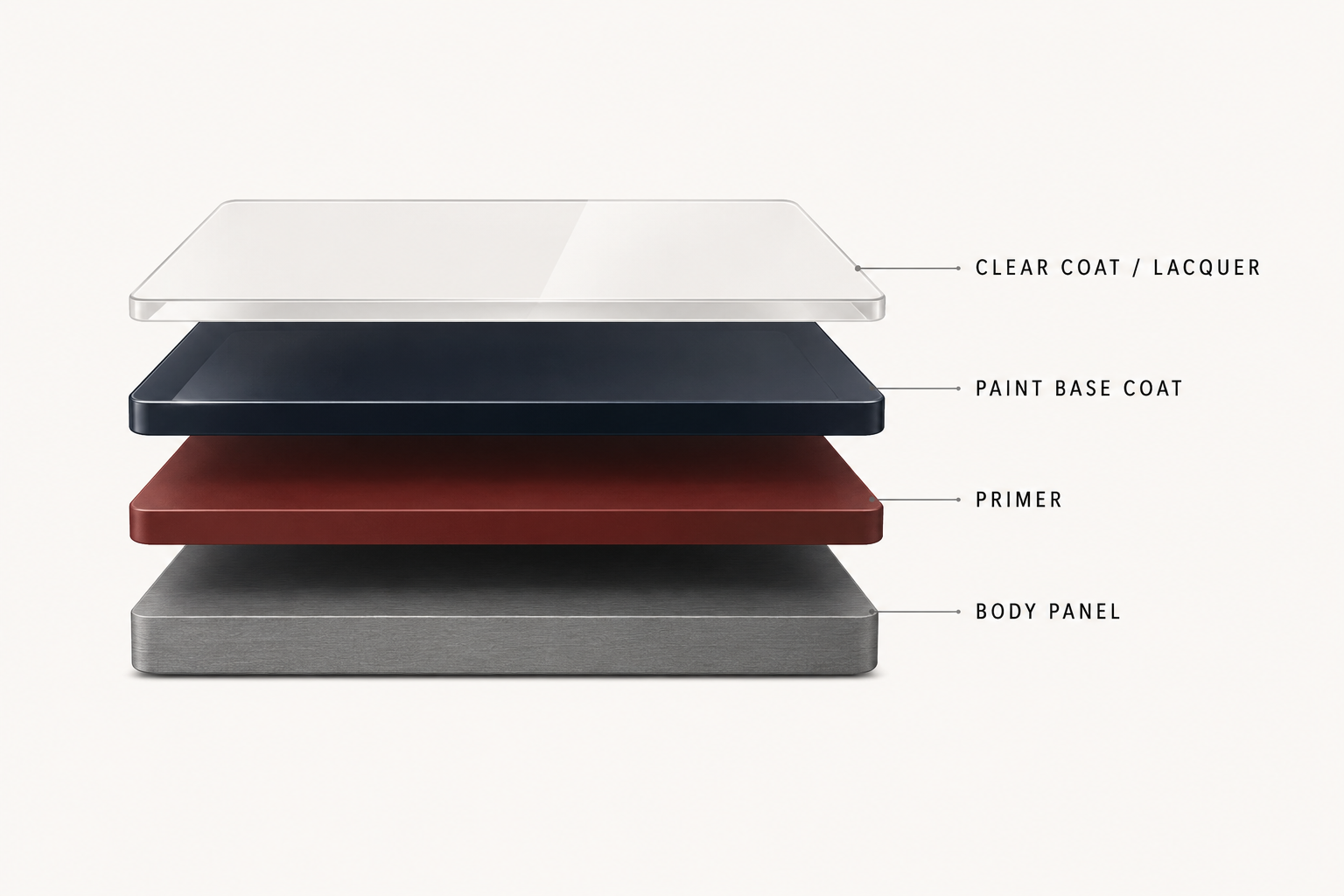
Your vehicle's exterior paintwork isn't just one layer of paint. It is a system of different layers, each serving a different purpose.
Your vehicle's paint system is made up of several layers, each serving a specific purpose. At the foundation is the metal body panel, which provides the vehicle with its structure and shape. Above this sits the primer, a preparatory layer that helps the paint adhere to the panel while providing protection to the underlying surface. The base coat, or colour coat, is then applied to give the vehicle its colour and visual appearance. Finally, the clear coat forms the transparent outer layer, providing gloss and acting as the first line of defence against everyday environmental exposure and chemical contamination. This is the layer you see and interact with every time you wash, dry or maintain your vehicle.
What is Ceramic Coating?
An extra layer of protection
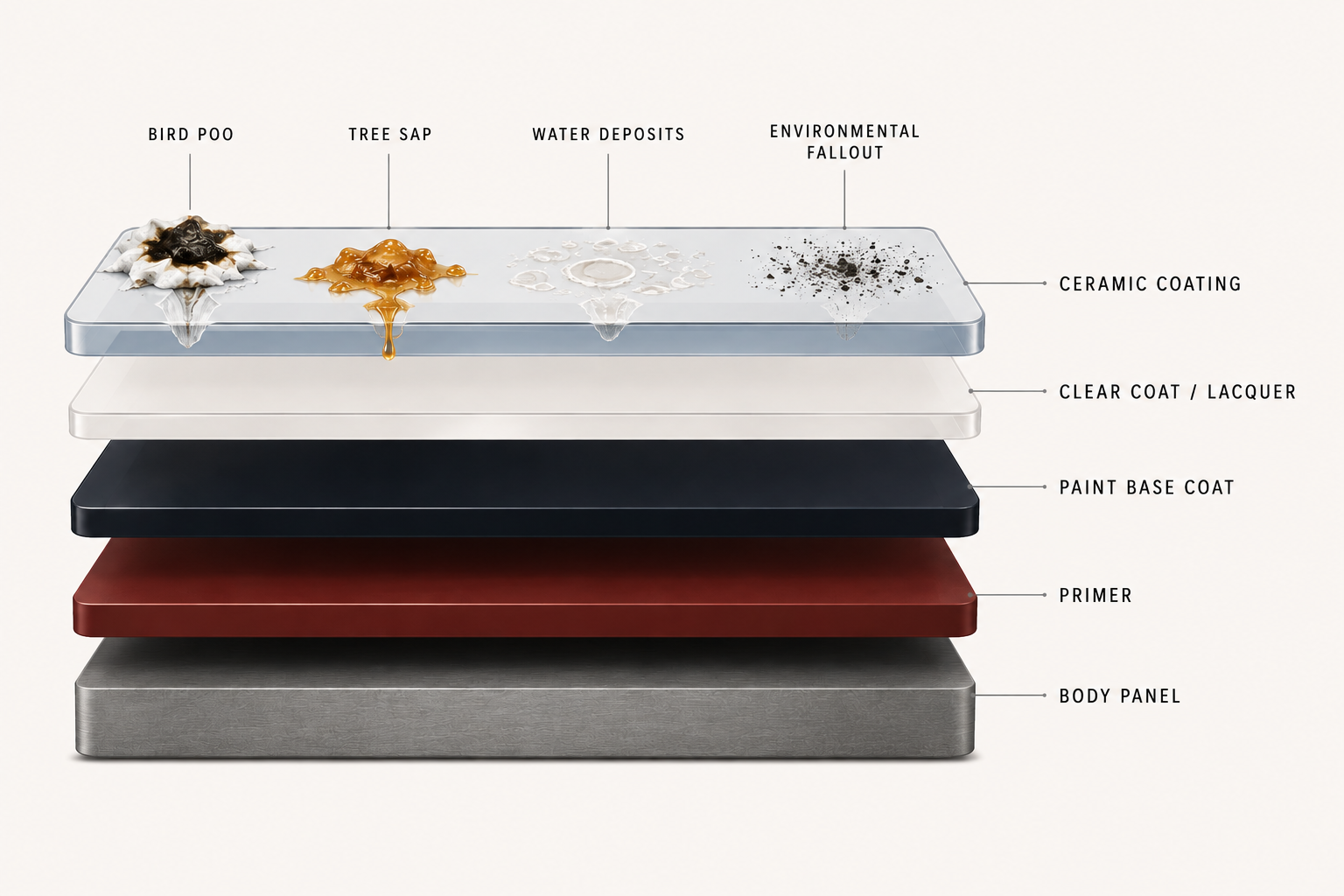
A ceramic coating is a liquid protective coating that is carefully applied to your vehicle's paintwork. Once applied and fully cured, it forms a durable, transparent layer that bonds to and sits on top of the clear coat, creating an additional layer of protection between your paintwork and the outside environment.
Unlike a traditional wax or sealant, a ceramic coating is designed to provide long-term protection, while enhancing gloss, water behaviour and ease of maintenance. Its hydrophobic properties help water, dirt and contaminants release more easily from the surface, helping your vehicle stay cleaner for longer.
The coating does not replace your clear coat or make the paintwork immune to damage. Instead, it acts as an additional protective barrier over the clear coat, helping to reduce the impact of everyday environmental contamination and making the vehicle easier to maintain.
Why Do I Need Ceramic Coating?
Protect against everyday damage
Your vehicle's paintwork is constantly exposed to contaminants that can gradually damage the clear coat. Bird droppings, tree sap, road salt, industrial fallout, hard-water deposits and other environmental contaminants can bond to the surface and, if left untreated, can chemically etch or degrade the clear coat. Over time, this can leave permanent marks that may require machine polishing — or, in more severe cases, paintwork correction or refinishing.
A ceramic coating sits on top of your clear coat as an additional protective barrier, helping to shield the underlying paintwork from everyday environmental contamination. Its hydrophobic properties also make it harder for water, dirt and contaminants to remain bonded to the surface, making the vehicle easier to clean and maintain.
It is important to understand that a ceramic coating does not make your paintwork scratch-proof or completely immune to damage. Instead, it provides an additional layer of protection that helps preserve the condition, gloss and appearance of your paintwork over time.
Benefits & Protection
What ceramic coating helps with
Chemical Resistance
The ceramic coating provides an additional barrier between the environment and your clear coat, helping protect the paintwork from chemical contamination such as bird droppings, tree sap, road grime and other contaminants that can stain or etch the surface.
UV & Environmental Protection
The coating adds another protective layer over the clear coat, helping reduce the effects of everyday environmental exposure and helping preserve the appearance of the paintwork over time.
Contamination Resistance
The coated surface is less prone to contaminants bonding strongly to the paintwork. This helps reduce the build-up of road grime, dirt and environmental contamination and makes them easier to remove safely.
Durability
Unlike traditional waxes and many sealants, professional ceramic coatings are designed to provide long-term protection. Their durability depends on the coating system, preparation, application, vehicle use and aftercare.
Properties
Properties of ceramic coating
Hydrophobic Surface
One of the defining properties of a ceramic coating is its hydrophobic behaviour. Water forms tighter beads and releases from the surface more readily, helping reduce water and contamination remaining on the paintwork.
Easier to Clean
Because dirt and contaminants are less likely to bond as aggressively to the coated surface, routine washing becomes easier and less effort is required to maintain the vehicle.
Enhanced Gloss
A ceramic coating can enhance the visual depth, gloss and clarity of properly prepared paintwork, helping the vehicle maintain a freshly detailed appearance.
Surface Slickness
The coating can increase surface slickness, depending on the coating system, helping contamination release more easily during maintenance.
Misconceptions
Ceramic coating myths, answered
Does ceramic coating make my car scratch-proof?
No. Ceramic coating provides an additional protective layer over the clear coat, but it does not make the paintwork immune to scratches, scuffs or physical damage. Deeper scratches and stone chips can still damage the paintwork.
Does ceramic coating prevent stone chips?
No. Ceramic coating is not designed to absorb impacts from stones or road debris. For physical impact protection, paint protection film (PPF) is the more suitable product.
Will ceramic coating stop bird droppings from damaging my paint?
No, but it can help. The coating provides additional chemical resistance and creates a less receptive surface for contamination. However, bird droppings can still be aggressive and should be removed as soon as possible rather than being left on the vehicle.
If my coating is hydrophobic, can I stop washing my car?
No. Ceramic coating makes your vehicle easier to clean; it does not make it maintenance-free. Dirt, road grime and contamination will still accumulate and need to be removed.
If my coating stops beading, has it failed?
Not necessarily. Reduced water beading can be caused by contamination building up on top of the coating. A proper wash and decontamination may restore the coating's hydrophobic behaviour. A lack of beading alone doesn't prove that the coating has failed.
Does ceramic coating prevent water spots?
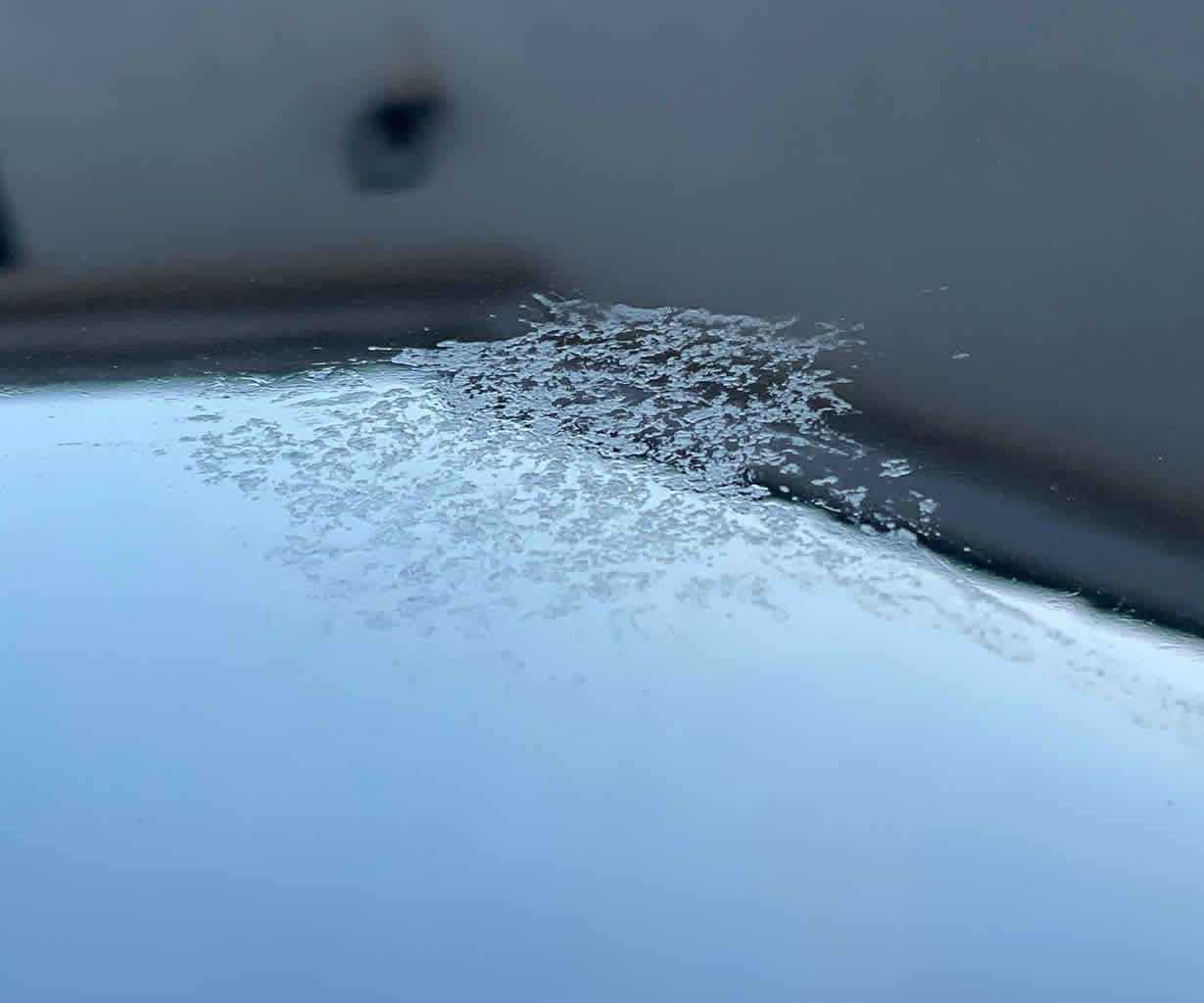
No. Water can still leave mineral deposits when it dries on the vehicle. The coating can make the surface easier to clean, but it cannot prevent minerals contained in water from being deposited.
Can I put ceramic coating over scratches?
You can, but it won't remove them. A ceramic coating follows the surface underneath it, so existing scratches and defects will remain visible. Where appropriate, paint correction should be carried out before coating.
Does ceramic coating replace paint correction?
No. Ceramic coating protects the paintwork; it does not correct defects within it. If the paint has significant swirls, haze or scratches, correction may be recommended before the coating is applied.
Is a more expensive ceramic coating always better?
Not necessarily. Coating performance depends on the formulation, preparation, application, curing, vehicle use and aftercare — not simply the price of the product.
Does a 5-year coating mean it will perform exactly the same for five years?
No. The stated durability is an indication of the coating's expected lifespan under suitable conditions. Washing methods, environmental exposure, mileage and maintenance can all affect its performance over time.
Can ceramic coating be applied to a dirty car?
No. Proper preparation is critical. The paintwork needs to be thoroughly cleaned and decontaminated, and may require polishing, before the coating is applied. Contamination left underneath the coating can affect the final result and bonding.
Does ceramic coating make my car completely maintenance-free?
No. Think of it as easier maintenance, not no maintenance. Regular and correct washing is still essential to keep the coating performing at its best.
Does water beading prove that a ceramic coating is still protecting my car?
Not on its own. Hydrophobicity is an important property of many ceramic coatings, but water behaviour alone isn't a complete measure of the coating's condition. Surface contamination can also change how water behaves.
Why do I still get water spots if my car has a ceramic coating?
Because ceramic coating does not prevent water spots. Water contains dissolved minerals, and when water is left to dry on the vehicle, those minerals can remain behind on the surface as deposits. A ceramic coating can make the surface more hydrophobic and easier to clean, but it cannot stop minerals from being left behind when contaminated water evaporates.
Ready to protect your paintwork?