
Why Wheels Need It
The harshest place on your car
Your wheels are exposed to some of the harshest conditions on the vehicle. Brake dust, road salt, traffic film, road grime, chemicals, heat and water repeatedly come into contact with the wheel surface.
An alloy wheel coating creates a durable protective layer over the wheel's finished surface, helping to reduce the amount of contamination that bonds directly to the wheel and making routine cleaning significantly easier.
- Brake dust
- Road grime
- Traffic film
- Road salt
- Mud and dirt
- Water and moisture
- Road chemicals
- Iron-rich brake particles
- Heat from braking
Brake dust contains iron-rich particles generated during braking. Combined with heat, moisture and repeated exposure, contamination can become increasingly difficult to remove and may contribute to staining or deterioration of the wheel's finish. A coating doesn't make the wheel immune — it helps stop contamination bonding as strongly in the first place.
What It Is
What is alloy wheel coating?
An alloy wheel coating is a liquid protective coating carefully applied to a prepared wheel surface. Once applied and cured, it forms a thin, chemically resistant protective layer over the wheel's existing finish.
Depending on the technology used, these products can contain silicon-based or ceramic-type chemistry such as siloxane, silane or silica-derived materials. During curing, the coating forms a tightly bonded protective film over the prepared surface.
Rather than allowing contamination to sit directly against the wheel's original finish, the coating provides an additional barrier between the wheel and its environment — leaving a surface that is more resistant to contamination, easier to clean and more resistant to everyday chemical exposure.
The Science
What changes at the surface
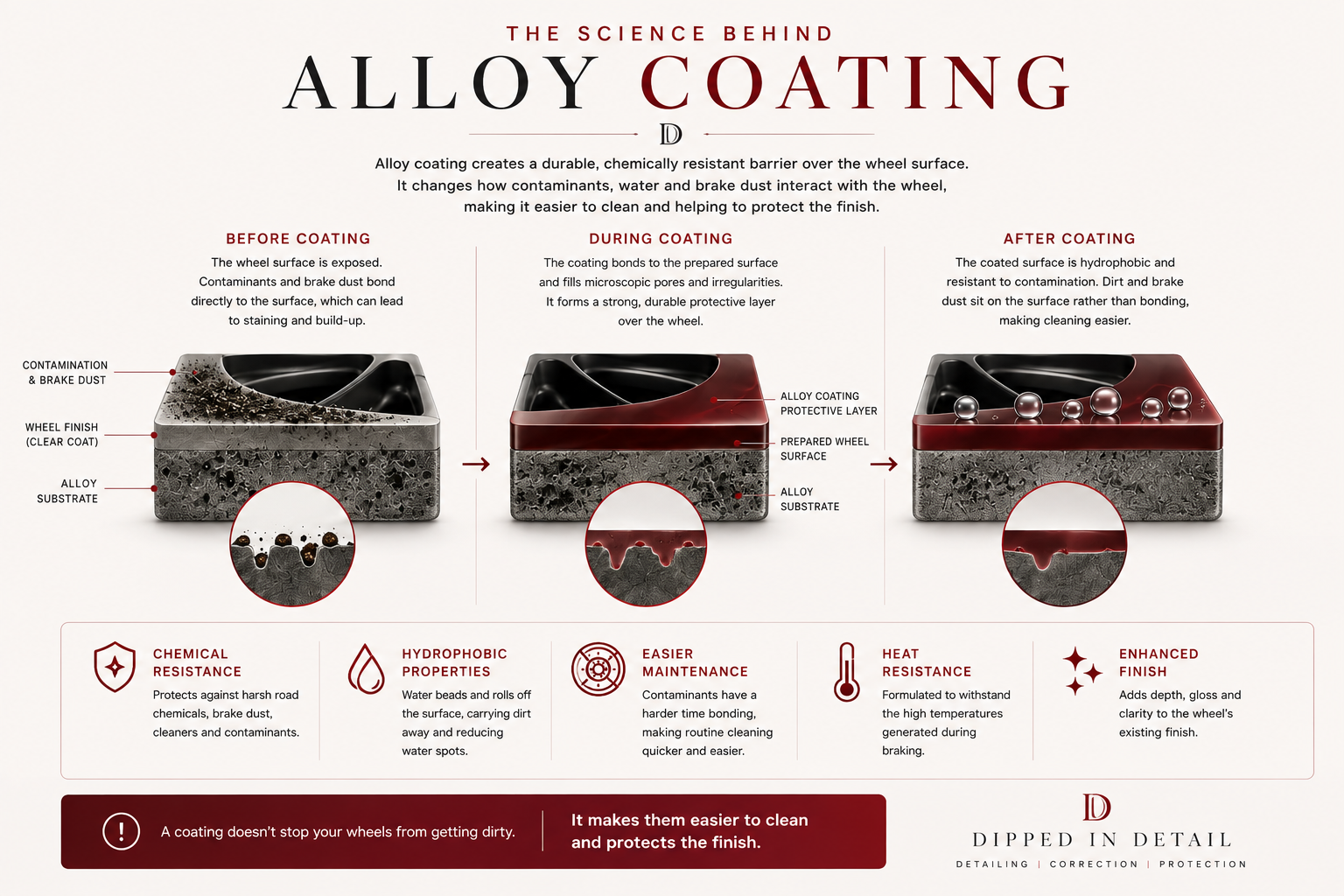
At a microscopic level, even a properly prepared wheel surface contains imperfections and irregularities. When contamination contacts an unprotected surface, it can adhere through a combination of mechanical bonding, chemical interaction and surface attraction.
Once cured, the coating creates a thin, continuous film over the wheel. That changes the surface energy and wetting characteristics, so water, dirt and brake dust interact with the wheel differently.
Hydrophobic Properties
Water-repelling, not self-cleaning
Instead of spreading across the surface into a thin film, water tends to form droplets with a higher contact angle and roll away more readily, carrying loose dirt with it during washing.
Hydrophobic does not mean dirt cannot stick. Brake dust and other contamination can still accumulate on a coated wheel — the advantage is that the surface is easier to clean and less prone to heavy bonding when properly maintained.
Benefits & Protection
What alloy coating helps with
Chemical Resistance
A cured coating provides an additional barrier against many of the chemicals a wheel encounters during normal use and maintenance, reducing direct exposure of the wheel's original finish.
Brake Dust Resistance
The coating reduces the tendency of contamination to strongly bond to the wheel surface, so brake dust is generally easier to remove during routine washing.
Easier Maintenance
With less opportunity for contamination to adhere, routine cleaning becomes considerably easier and a coated wheel should need less aggressive cleaning than an unprotected one.
Hydrophobic Behaviour
Water tends to bead and move across the surface rather than spreading into a film, reducing water retention and helping during washing and drying.
Gloss & Finish Enhancement
On a properly prepared wheel a coating can enhance visual depth and gloss. It does not repair damaged or corroded wheels — preparation is what determines the final appearance.
Heat Resistance
Wheel-specific coatings are formulated to withstand the elevated temperatures generated during normal and heavy braking.
Preparation
A coating only performs as well as the surface underneath
Before applying an alloy coating, the wheel is thoroughly cleaned and decontaminated. That typically means removing:
- Brake dust
- Iron contamination
- Tar
- Road grime
- Old protection
- Oils and residues
If contamination, oils or residues remain underneath the coating, they can interfere with bonding and affect performance. The coating doesn't hide a poor surface — it protects the surface you give it.
Curing
What happens after application
After application the coating needs time to cure. During curing, its chemical components react and transform the initially liquid product into a much more stable protective film.
This is why the vehicle should be kept away from unnecessary contamination and moisture during the initial curing period, in line with the coating manufacturer's instructions. Once fully cured, the coating becomes the protective layer sitting between the wheel and the environment.
Aftercare
Keeping the coating performing
Wash coated wheels regularly using appropriate wheel-safe products and safe washing techniques, and avoid letting heavy brake dust and road contamination build up for prolonged periods.
Over time a coated surface can become clogged with contamination, and you may notice water behaviour and ease of cleaning aren't quite what they were when the coating was fresh. That doesn't necessarily mean the coating has failed — a professional decontamination wash can remove accumulated contamination and restore its surface characteristics.
We can maintain your coating for you. Regular professional maintenance helps keep the surface clean, hydrophobic and performing as intended, while reducing the need for aggressive cleaning.
Misconceptions
Alloy coating myths, answered
“The coating means I never have to clean my wheels.”
No. The coating makes maintenance easier; it doesn't eliminate the need to wash the wheels.
“Brake dust won't stick to coated wheels.”
Brake dust can still accumulate. The coating helps reduce how strongly contamination bonds to the surface.
“If the coating stops beading, it has failed.”
Not necessarily. The coating can become contaminated or clogged. A proper decontamination process may restore its hydrophobic behaviour.
“A coating will protect against kerbed alloys.”
No. Wheel coatings are not designed to prevent physical damage from kerbing, impacts or deep scratches.
“A coating will fix corrosion.”
No. Corrosion and damaged finishes need to be addressed before coating. A coating is a protective treatment, not a wheel refurbishment process.
FAQs
Alloy coating questions
How long does alloy coating last?+
The lifespan depends on the specific coating, preparation, environmental exposure and aftercare. Always follow the stated durability of the particular coating being applied.
Can you coat new wheels?+
Yes. New wheels are excellent candidates because the surface can be prepared and protected before significant contamination builds up.
Can you coat wheels that are already on the car?+
Yes, depending on accessibility and the condition of the wheels. For the highest level of preparation, removing the wheels may sometimes be preferable.
Does alloy coating protect against kerbing?+
No. The coating provides chemical and contamination resistance but does not provide meaningful protection against physical impacts or kerb damage.
Can I use normal wheel cleaner on coated wheels?+
Use a coating-safe, wheel-safe cleaning product and avoid unnecessarily aggressive chemicals. The exact maintenance requirements depend on the coating used.
Why are my coated wheels still getting dirty?+
Because the coating doesn't prevent contamination from reaching the wheel. It changes how contamination interacts with the surface, making it easier to remove.
Why has my wheel stopped beading?+
The surface may have become contaminated or clogged. A professional decontamination wash can often restore the coating's surface behaviour.
Can I coat wheels with existing corrosion?+
The wheel should be assessed first. Coating over significant corrosion or damaged lacquer is unlikely to produce the desired result — the underlying finish needs to be suitable.
Can alloy coating be applied to gloss black wheels?+
Yes, provided the surface is suitable and properly prepared.
Does the coating add gloss?+
It can enhance the appearance of a properly prepared finish, particularly on gloss surfaces, but it won't correct scratches, oxidation or other defects underneath.
Is alloy coating worth it?+
For vehicles that regularly accumulate brake dust or are difficult to maintain, the main benefit is easier maintenance and improved resistance to contamination and chemical exposure.
Ready to protect your wheels?